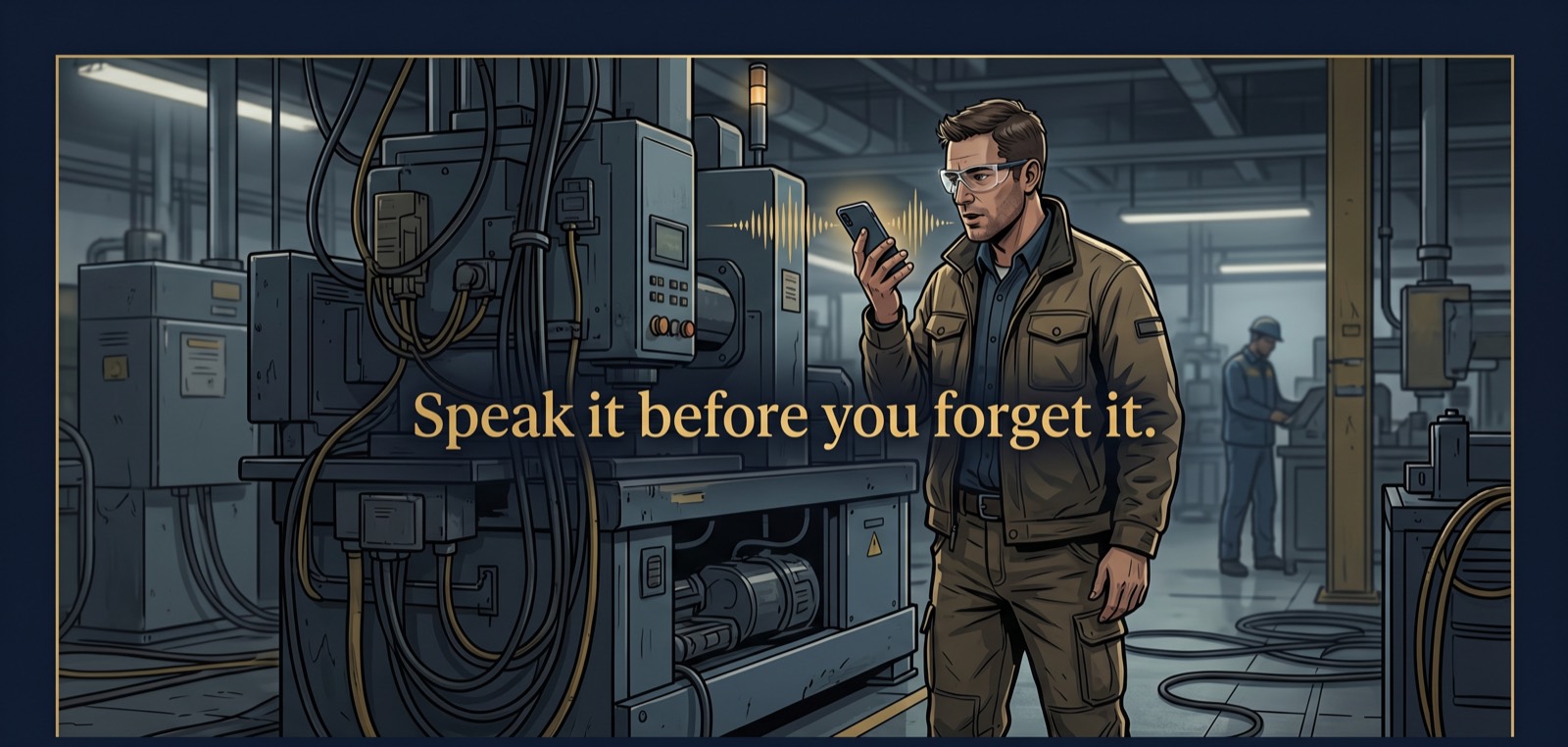
In technical field sales, notes are everything.
Not because your manager wants them. Not because your CRM requires them. Because the moment you walk away from a machine on a plant floor, the details start fading. The customer mentioned a specific pressure threshold. There was a clearance issue on the left side of the conveyor. The existing drive was a legacy unit with no network card. Thirty minutes later, in your next account, those details are already competing with new information.
The note you took — or didn't take — is the difference between a proposal that hits the mark and one that misses it entirely.
The conference room that doesn't exist
Here's the version of technical sales that software and productivity tools seem to imagine: you sit across from a customer in a clean conference room, laptop open, plenty of time to type detailed notes while they walk you through their requirements.
That's not automation sales.
Automation sales is standing in front of a machine on a loud plant floor, trying to hear a customer over the ambient noise of a running production line, wearing safety glasses that fogged up when you walked in from the cold, possibly with work gloves on. You're looking at an application, taking pictures with your phone, and trying to capture everything relevant before you move to the next machine fifteen feet away.
You do not have a free hand and a quiet room. You have thirty seconds and whatever you can scribble before the customer moves on.
The gear problem
Reps solve this differently. Notepads. Folders. Sticky notes. Digital tablets. E-ink devices with a stylus. Some combination of all of the above depending on the day.
The problem is consistency. You can't guarantee you'll have all of those tools with you at every account, for every impromptu plant walk that wasn't on the original agenda. Customers don't always schedule the moment they decide to show you something.
Your phone is the one thing you always have.
What it looks like when it works
Imagine standing in front of a machine, seeing exactly what the customer is describing, and being able to speak a note in five seconds. Not type it. Not scribble it. Speak it — accurately, with the technical terms intact — and move on to the next machine.
Then attach the photo you just took. Right there, before you walk away.
Even if the details start fading by the time you're back at your vehicle, it doesn't matter. Everything you said is saved, synced, and searchable. Not buried in a notepad you'll have to decipher later. Not reconstructed from memory at 9pm. Actually there, word for word, ready to review.
And when you need a summary of your last three site visits before a follow-up call? AI can pull that together in seconds. What you saw, what the customer said, what the open questions were. All of it, without digging through anything.
You don't need a tablet. You don't need a laptop. You don't need the perfect setup or the right gear on the right day.
You need your phone and a few seconds to speak into it. That's it.